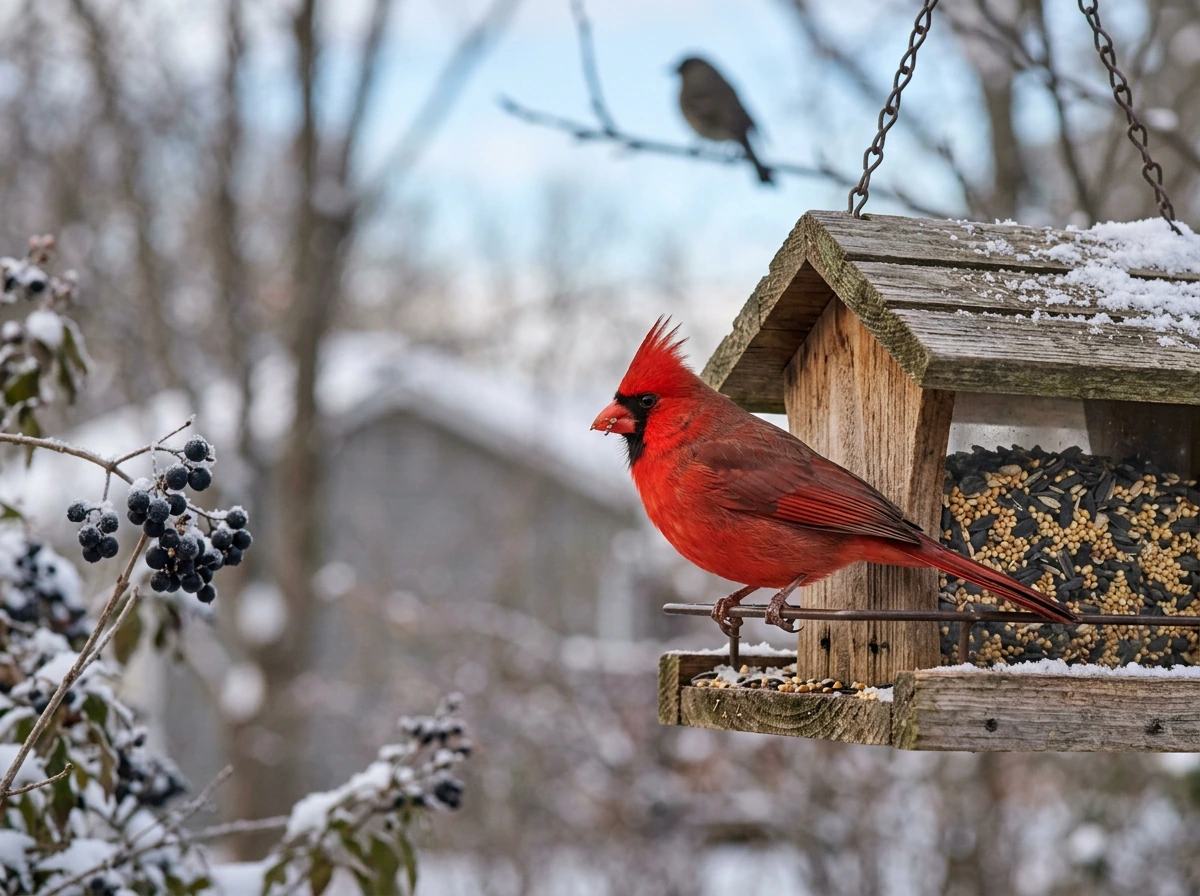
If a red bird just crossed your path and you felt that little pull in your chest, that sense that it meant something, you're in the right place. The spiritual meaning of a red bird centers on vitality, passion, love, renewal, and messages from beyond the everyday. Whether it was a cardinal perched on your fence, a robin hopping across your yard, or another flash of red that stopped you mid-thought, the encounter is worth sitting with. This guide will walk you through what red birds symbolize spiritually, how to read the specific context of your encounter today, and what to do next so the message actually lands for you.
Spiritual Meaning of a Red Bird: What It Means When You See One

Eliza Thornwick
24 Mar 2026
What a red bird symbolizes spiritually
Red birds carry a striking combination of symbolism built from two powerful layers: the color red and the nature of birds themselves. In virtually every spiritual and cultural tradition, birds are considered messengers, creatures that move between the earthly world and something higher. They appear, catch our attention, and disappear. That liminal quality is exactly why so many people instinctively feel that a bird sighting is more than coincidence.
The color red adds its own weight. Across Western symbolism and esoteric traditions, red is linked to vitality, energy, courage, passion, and love. It's the color of the heart, of blood, of life force itself. In some correspondence systems it's mapped to Mars, a planet associated with strength, drive, and action. So when you combine a messenger creature with the most attention-grabbing color in nature, you get something spiritually potent: a signal that asks you to pay attention to your life force, your heart, and whatever you've been putting off.
That said, red also carries dual energy. It can signal warning or danger just as readily as love and passion. This is actually useful information when you're trying to interpret your encounter, because it means the message isn't always warm and reassuring. Sometimes a red bird is nudging you to notice something you've been ignoring, or to act with urgency on something important. The tone of the message depends heavily on context, which we'll get into shortly.
What it means when you see a red bird today
Seeing a red bird, especially when it feels deliberate or catches you off guard, is most commonly interpreted across spiritual traditions as one of these things: a message from a loved one who has passed, a reminder to reconnect with your passion and purpose, a sign of love and devotion (either incoming or already present in your life), or an invitation toward renewal and transformation.
The 'message from a departed loved one' interpretation is probably the most widely shared belief around red birds, especially cardinals. Many people who have lost someone close report seeing a cardinal appear shortly after the loss or on significant dates like birthdays and anniversaries. Whether or not you hold a specific spiritual belief system, this interpretation resonates because it captures the feeling many people describe: that the bird felt personal, like it was there specifically for them.
The renewal and transformation theme is equally common, and it's worth taking seriously if you're in a period of change right now. Popular spiritual guides consistently frame red bird sightings as signs of manifestation, fresh starts, and the energy needed to move through transition. If you've been sitting on a decision, or if life has felt stagnant, a red bird appearing today can be read as confirmation: this is your moment to move.
Love and devotion is a third strong theme. Spiritual interpretation guides frequently describe red bird encounters using the language of the heart, loyalty, deep connection, emotional attunement. If your mind went to a specific person when the bird appeared, that association is probably worth following.
How to read the context of your specific encounter
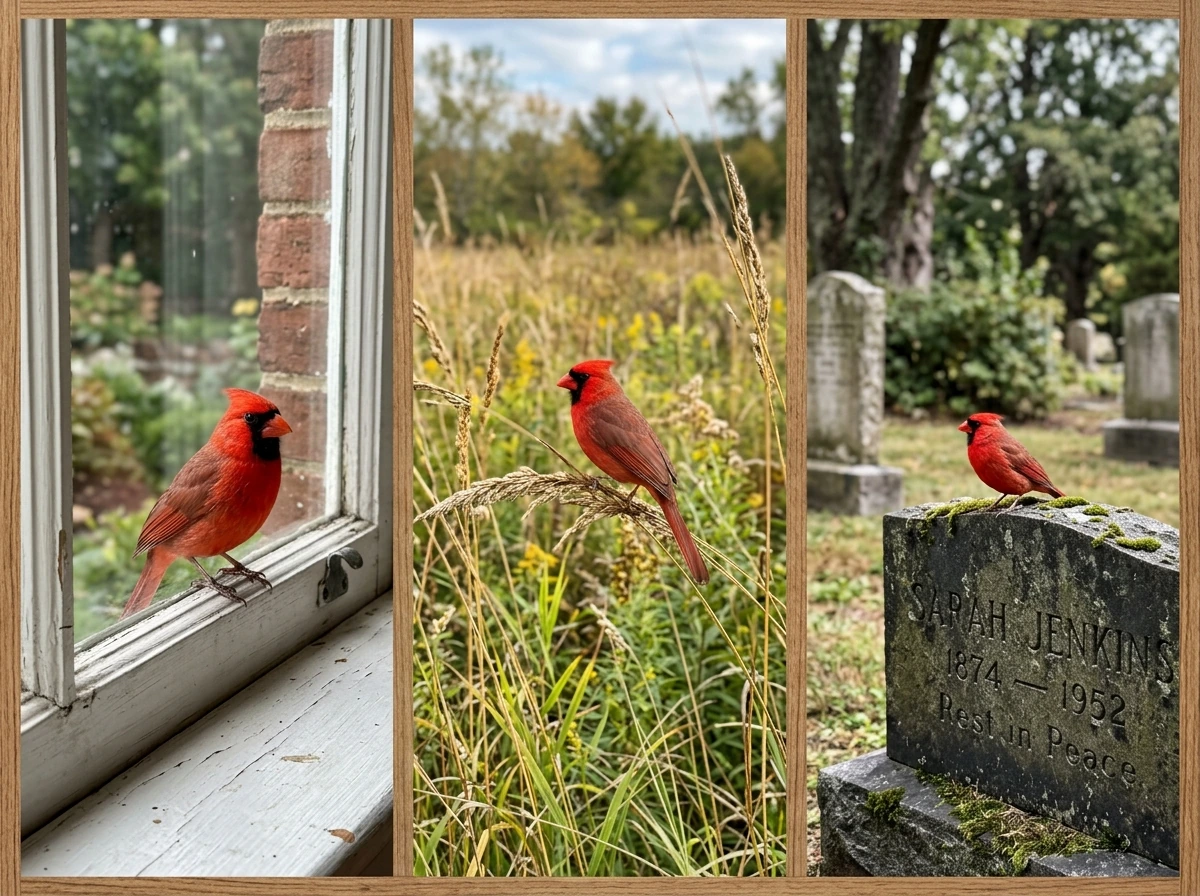
Here's where the interpretation gets personal and specific. The same bird can carry very different messages depending on where it appeared, what it was doing, when you saw it, and what was going on in your life at that moment. Context is everything.
Where the bird appeared
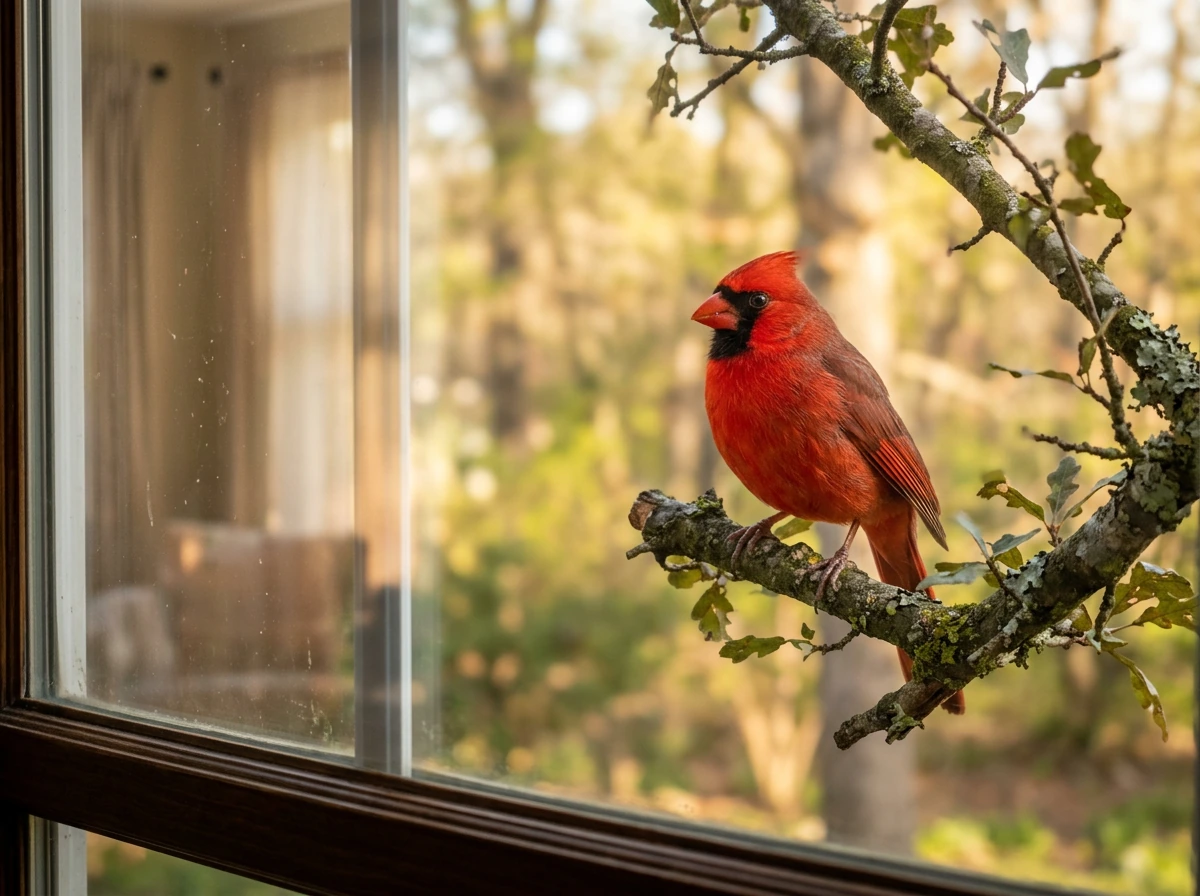
A red bird at your window carries different energy than one in an open field or perched on a grave marker. Window appearances often feel more urgent or intimate, the bird is quite literally coming to you. From a purely behavioral standpoint, birds sometimes strike or hover near windows because they see their reflection and perceive a rival. But spiritually, a bird at your window is widely read as a message trying to get your attention, especially if it lingered or looked directly at you. A bird in your yard during a quiet morning feels more like a gentle reminder, while one that appears in an unexpected urban or indoor context tends to feel more significant simply because it's out of place.
What the bird was doing
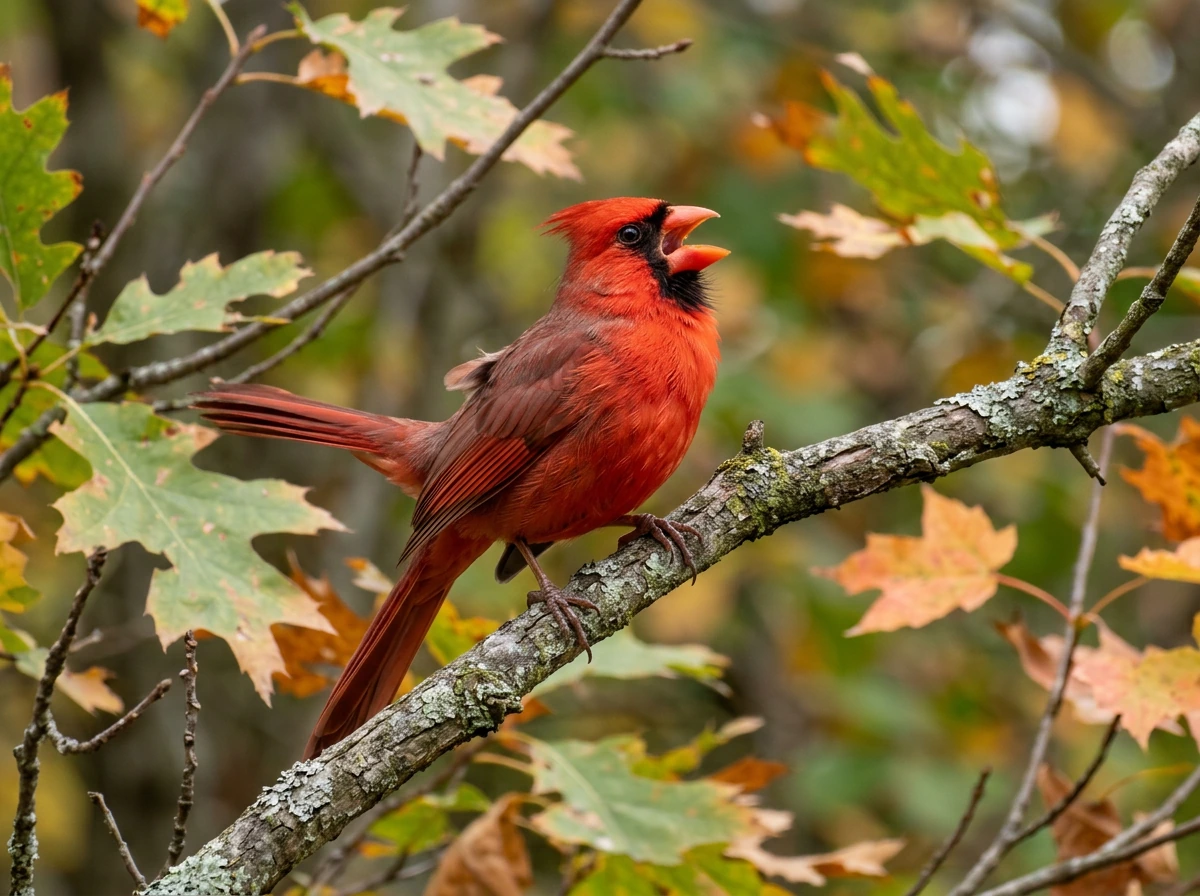
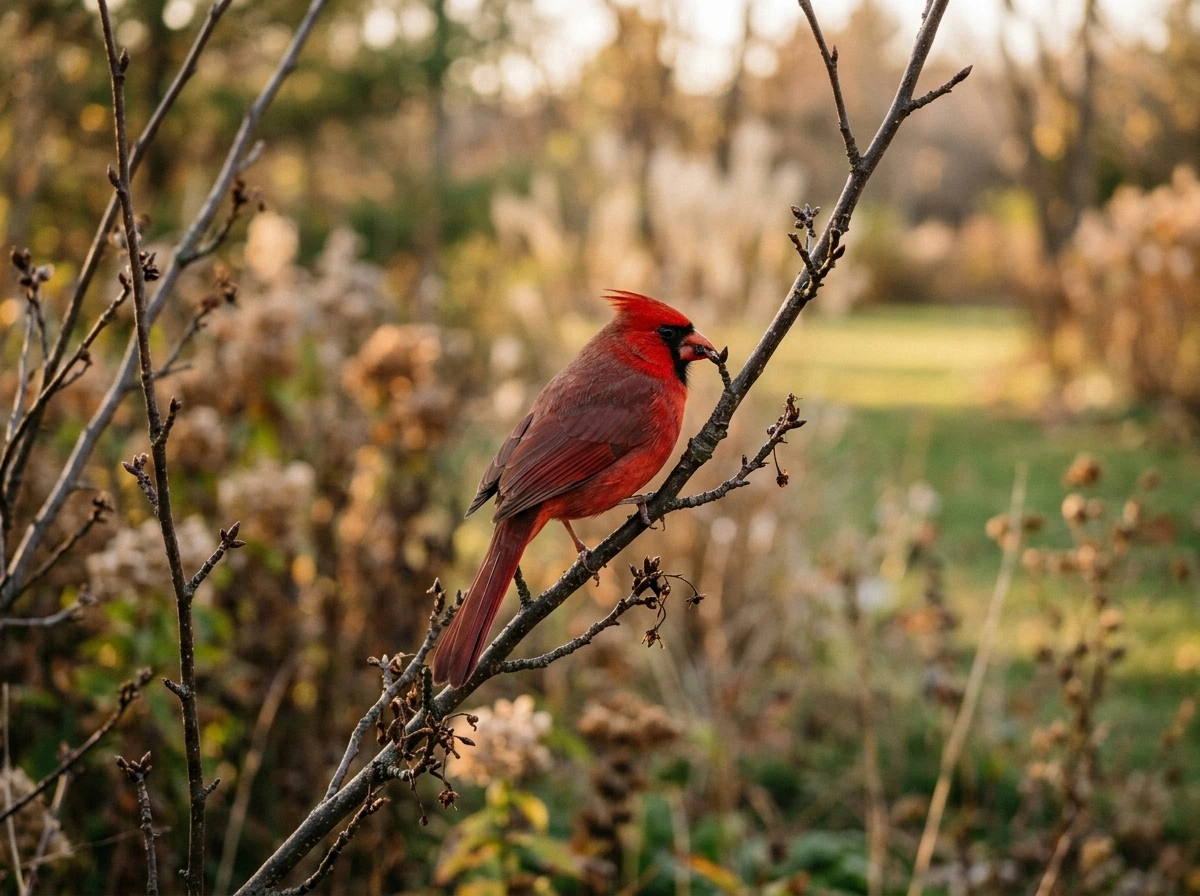
Behavior matters. A male cardinal singing loudly and repeatedly from a branch is engaged in territorial display, that's useful to know, because it doesn't necessarily carry the same 'quiet message' energy as a bird that simply lands nearby, looks at you, and then flies off. A bird that seems to follow your movement, or that returns multiple times over days, is generally interpreted as a stronger or more persistent message. A bird that arrives, holds your gaze briefly, and disappears feels more like a single pointed communication.
When it appeared
Timing adds layer. Did the bird appear right after you were thinking about someone who died? During a moment of grief, doubt, or major decision-making? On a meaningful date? Spiritual interpretation frameworks consistently suggest that timing isn't random, your emotional and mental state in the moment of the encounter is part of the message itself. A red bird appearing when you're already mid-thought about love, loss, or change amplifies and confirms that thread.
Your emotional reaction in the moment
This one gets overlooked, but your gut response when the bird appeared is some of the most reliable data you have. Did you feel warmth, comfort, or a sudden sense of peace? That typically points toward a message of love, reassurance, or confirmation. Did you feel a jolt of urgency or mild unease? That's worth noting too, some spiritual discernment traditions describe this kind of 'agitation' as a signal to pay attention to something misaligned in your current path. Peace and clarity after an encounter are widely recognized as markers of authentic spiritual guidance, while restlessness can be an invitation to look more carefully at what needs to change.
The core spiritual themes red birds tend to carry
Across the most common spiritual frameworks for interpreting red bird encounters, a handful of themes come up again and again. None of these are fixed, they're starting points for your own reflection.
| Theme | What it might be pointing to | Feels most relevant when... |
|---|---|---|
| Love and devotion | Deep connection, heart matters, romantic or familial bonds | You've been thinking about a relationship or feeling lonely |
| Message from a loved one | A departed person sending reassurance or love | You recently lost someone or are approaching an anniversary |
| Vitality and passion | Reconnecting with what lights you up, taking action | You've felt flat, unmotivated, or disconnected from your purpose |
| Renewal and transformation | A fresh start, moving through a transition | You're mid-change or sitting on a decision you've delayed |
| Warning or urgency | Something needs your attention now | The encounter felt charged rather than comforting |
| Courage and strength | You have what it takes to move through something hard | You're facing fear or hesitation around a next step |
| Loyalty and protection | You are watched over, supported, or need to protect something | You're feeling isolated or in need of reassurance |
It's worth noting that these themes aren't mutually exclusive. A single encounter can carry more than one. Trust the themes that feel alive for you right now, and set aside the ones that don't resonate, that distinction itself is useful information.
How to actually use the message (reflection, journaling, next steps)

Noticing the encounter is the first step. Making it useful is the second. Here's a simple practice you can do today, right after reading this.
- Write down the encounter while it's fresh. Where were you, what were you thinking about, what was the bird doing, and how did you feel when you saw it? Don't filter — just write. This becomes the raw material for your interpretation.
- Pick the one theme from the list above that felt most alive when you read it. Write a few sentences about why that theme resonates right now. What's actually going on in your life that connects to it?
- Ask yourself one honest question: 'If this encounter was a nudge, what would it be nudging me toward?' Write whatever comes first, before your rational mind can edit it.
- Check your internal response. Does thinking about that answer bring you a sense of peace and rightness, or does it bring anxiety and resistance? Spiritual discernment traditions across multiple frameworks use this inner compass — peace as confirmation, restlessness as a cue to look deeper.
- Choose one small, concrete action. Even just a phone call to someone you love, a few minutes of quiet, or a single line in your journal about a decision you've been avoiding. The message isn't meant to stay abstract — it's meant to move you somewhere.
Journaling doesn't have to be elaborate. Journaling doesn't have to be elaborate. Henri Nouwen, one of the most widely read spiritual writers of the last century, practiced daily journaling specifically to discern meaning in ordinary encounters, nature, people, moments in daily life. The practice works because writing slows you down enough to actually hear what an encounter is pointing toward, rather than carrying it around as a vague feeling that eventually fades. The practice works because writing slows you down enough to actually hear what an encounter is pointing toward, rather than carrying it around as a vague feeling that eventually fades.
When meanings differ: tradition, culture, and your own read
Red birds don't mean exactly the same thing everywhere, and it's worth knowing that before you settle too firmly on one interpretation. The most spiritually curious approach is to hold multiple traditions lightly and notice which one resonates for your specific encounter.
In many Native American traditions, the cardinal is considered a messenger and is associated with relationships, vitality, and spiritual connection. In Christian symbolism, red carries the weight of blood, sacrifice, and the fire of the Holy Spirit, so a red bird in that context can feel like a sign of spiritual awakening or protection. In some Celtic and European folk traditions, robins in particular are linked to both renewal and death omens. In Scotland, a robin's song near someone who is ill was historically considered an ill omen, a stark contrast to the 'joyful messenger' framing common in American spiritual culture, which is why the robin bird spiritual meaning can feel so different depending on the context. american robin bird spiritual meaning
Even in Japanese and Shinto traditions, the color red (vermilion specifically) is considered sacred and protective, think of the iconic red torii gates. Red in that context signals a threshold between the mundane and the divine, which maps interestingly onto the 'messenger between worlds' quality that birds already carry.
The specific species matters too, though people often use 'red bird' to mean multiple birds. Cardinals and robins are the most common red birds people encounter in North America, and while they share the 'red bird' label, their specific spiritual associations can diverge. Cardinals tend to carry stronger associations with love, loyalty, and messages from departed loved ones. Robins are more tied to renewal, spring energy, and emotional fresh starts. If you want to go deeper on either of those, the articles on cardinal bird spiritual meaning and robin bird spiritual meaning cover the species-specific symbolism in much more detail.
Ultimately, and this isn't a cop-out, the most reliable interpretation is the one that resonates in your gut. Mainstream spiritual guides across traditions consistently say the same thing: the encounter's meaning is shaped by your context, your life, and what you bring to it. The traditions give you a vocabulary and a starting point. Your own inner response tells you which word fits.
So if a red bird stopped you today, treat it as an invitation to pause. Not to decode a fixed message from a universal rulebook, but to check in, with your heart, your current chapter, and whatever you've been carrying around without addressing. That pause itself might be exactly what the bird came to give you.
FAQ
What should I do if I see a red bird but I do not feel anything spiritual or emotional in the moment?
Treat it as information rather than a sign that you missed “the message.” Re-check your interpretation after a few hours or the next day, and ask yourself what you were doing right before the sighting (for example, deciding, grieving, or avoiding a conversation). If nothing clicks, journal the facts only, then look for a theme that emerges later.
Does seeing a red bird at night mean something different than seeing one in daylight?
Many people find nighttime sightings feel more intense or “closer,” but the more actionable difference is practical context. If the bird appeared near you during nighttime, note the circumstances (window, porch light, how long it lingered), then compare your feelings (peace versus unease). Treat the emotional tone and persistence as the higher-signal indicators than the time of day.
What if the bird appears repeatedly, like every morning, or even follows my movement around the house?
Repetition usually shifts the interpretation from a single “communication” to an ongoing nudge. Make a simple log for a few days (date, location, behavior, your mood at the time). Look for one recurring life topic you keep circling, such as relationship strain, health concerns, or a postponed decision.
How do I know whether I am interpreting the red bird as a warning versus a reassurance?
Use your body and your next-step options. If you felt a jolt of urgency or mild unease, ask what concrete action would reduce risk or misalignment (for example, checking in with someone, ending a habit that drains you, or making a needed plan). If you felt calm clarity, choose a constructive next step aligned with growth, such as reaching out, starting the project, or setting a boundary.
Can a red bird sighting be “about” someone else, not me?
Yes, especially if you strongly associate the bird with a specific person. Still, verify it by your own pattern of attention: did you already have that person on your mind, or did the sighting interrupt you into awareness? If it is about them, your next step is usually supportive, like sending a thoughtful message or offering practical help, rather than making assumptions about their private state.
Does species matter if I only know it was a red bird (cardinal versus robin)?
It often matters. Cardinals are frequently interpreted with heavier themes of love, loyalty, and messages from departed loved ones, while robins are more often linked to renewal and emotional fresh starts. If you are unsure which species it was, focus on the bird’s behavior (singing, lingering, location, and whether it appears during transition moments) to anchor your meaning.
What if the “red bird” was actually a different animal, like a red-winged blackbird or a red-colored jay?
Then the safest approach is to avoid forcing the specific red-bird symbolism. Note the exact species, or at least the distinctive features, and use the encounter framework more generally: birds as messengers, red as vitality and intensity, and context as the differentiator. If you cannot identify it, treat it as a prompt to pause and self-check rather than a species-specific prophecy.
Is it normal to feel overwhelmed after seeing a red bird, especially if it brings up grief?
Yes, and it can be a sign that the sighting is pulling a real emotion to the surface. If grief spikes, give yourself a grounded response: breathe slowly for a minute, write the feeling in one sentence, and choose one gentle action (light a candle, visit a place that matters, or talk to someone safe). If the distress becomes persistent, consider reaching out to a grief-informed counselor or support group.
How can I record the encounter so I do not lose the meaning after the feeling fades?
Use a five-line journal entry: what happened (species and location), what the bird did (looked at you, sang, lingered), what you were thinking about, your body reaction (peace, urgency, discomfort), and one possible next step. Re-read it after one week, the meaning usually becomes clearer once you have distance.
Should I tell other people about my red bird “message”?
Only if it will help and you can share it lightly. Spiritual interpretations can be personal and may land differently for someone else. A useful approach is to say what you plan to do (for example, “I’m taking this as a reminder to follow through on something I’ve been avoiding”), rather than presenting it as certainty about anyone’s future.
Next Article
Cardinal Bird Spiritual Meaning: Red, Blue, and Black Insights
Interpret cardinal bird spiritual and biblical meanings, with color guidance for red, blue, and black sightings.